A worked example is the cheapest kind of proof: the source shows its letters and its sums, so a different calculator can be checked against it line by line. The three below come from one 1926 handbook, and each exposes a different decision in the method rather than merely repeating the same arithmetic.
The book's notation
Taylor writes some results as a pair or a trio rather than a single number. "11-9" means the month and day formed 11 and the year reduced to 9; "22-8-11" means the three name parts reduced to those values; "1-11" means a single digit was added to a retained master. The notation records the components before they are added, which is why a modern reader who expects one number can mistake a partial result for the answer (Taylor 1926 pp. 23, 56).
Calvin Coolidge: a date pair and a name total
The book gives Coolidge's birth date as the pair 11-9: July 4 forms 11, and 1872 reduces to 9. Adding the two gives 20, which reduces to 2, the Life Path the calculator shows. The name is worked word by word: CALVIN totals 25, reducing to 7; COOLIDGE totals 43, reducing to 7; the two sevens add to 14 and reduce to 5.
| Number | Raw | Result | The book |
|---|---|---|---|
| Life Path (1872-07-04) | 7 + 4 + 9 = 20 | 2 | prints the pair 11-9 |
| CALVIN | 3+1+3+4+9+5 = 25 | 25 | reduces this word |
| COOLIDGE | 3+6+6+3+9+4+7+5 = 43 | 43 | reduces this word |
| Expression | 68 | 5 | 25 and 43 → 7 + 7 = 14 → 5 |
| Soul Urge | 36 | 9 | 10 + 26 = 36 → 9 |
| Personality | 32 | 5 | 6 + 8 = 14 → 5 |
| Chaldean name number | 52 | 7 | not in the book |
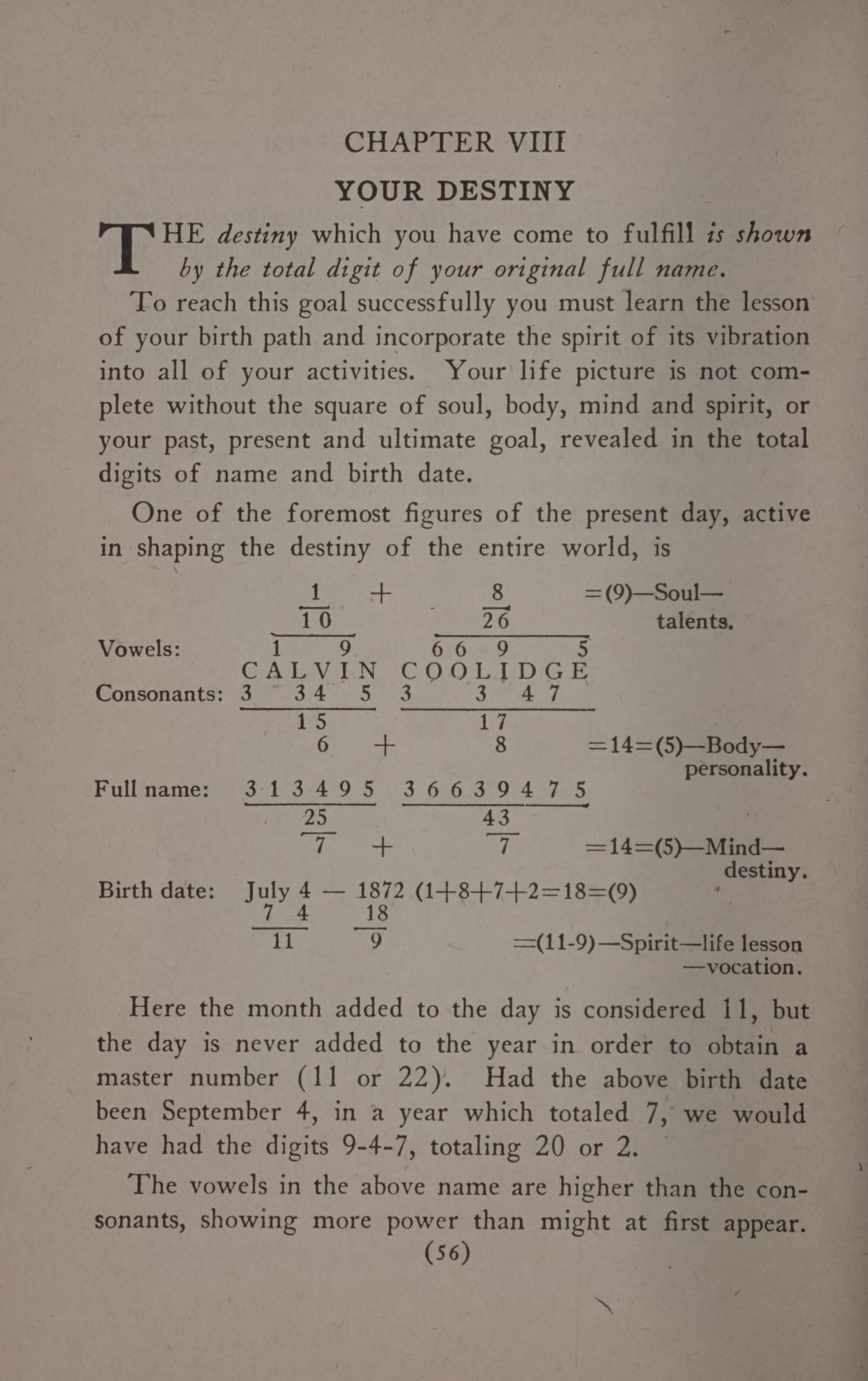
For this name the totals differ from the book in their intermediate step, not in their result: Taylor reduces each word's letters separately and adds the reduced parts. This site sums every letter of the name and reduces once, which is the same rule stated on How we calculate. Both paths reach 5 here, so the example cannot tell the two orders apart; Rockefeller's Expression can, and it is shown below.
David Wark Griffith: the master numbers in every position
Taylor calls this an unusual case because master numbers appear in the vowel sum, the consonant sum and two of the three name parts. The book prints 22-8-11 for the parts and does not add them, because two carry masters. The calculator adds every letter and reduces the total to 5; the per-word masters remain visible in its chart but do not feed the Expression.
| Number | Raw | Result | The book |
|---|---|---|---|
| DAVID (word sum) | 4+1+4+9+4 = 22 | 22 | 22 |
| WARK (word sum) | 5+1+9+2 = 17 | 17 | 8 |
| GRIFFITH (word sum) | 7+9+9+6+6+9+2+8 = 56 | 56 | 11 |
| Expression | 95 | 5 | does not add the parts (prints 22-8-11) |
| Soul Urge | 29 | 11 | 11 |
| Personality | 66 | 3 | 1-11 (keeps the 11 of Griffith) |
| Chaldean name number | 59 | 5 | not in the book |
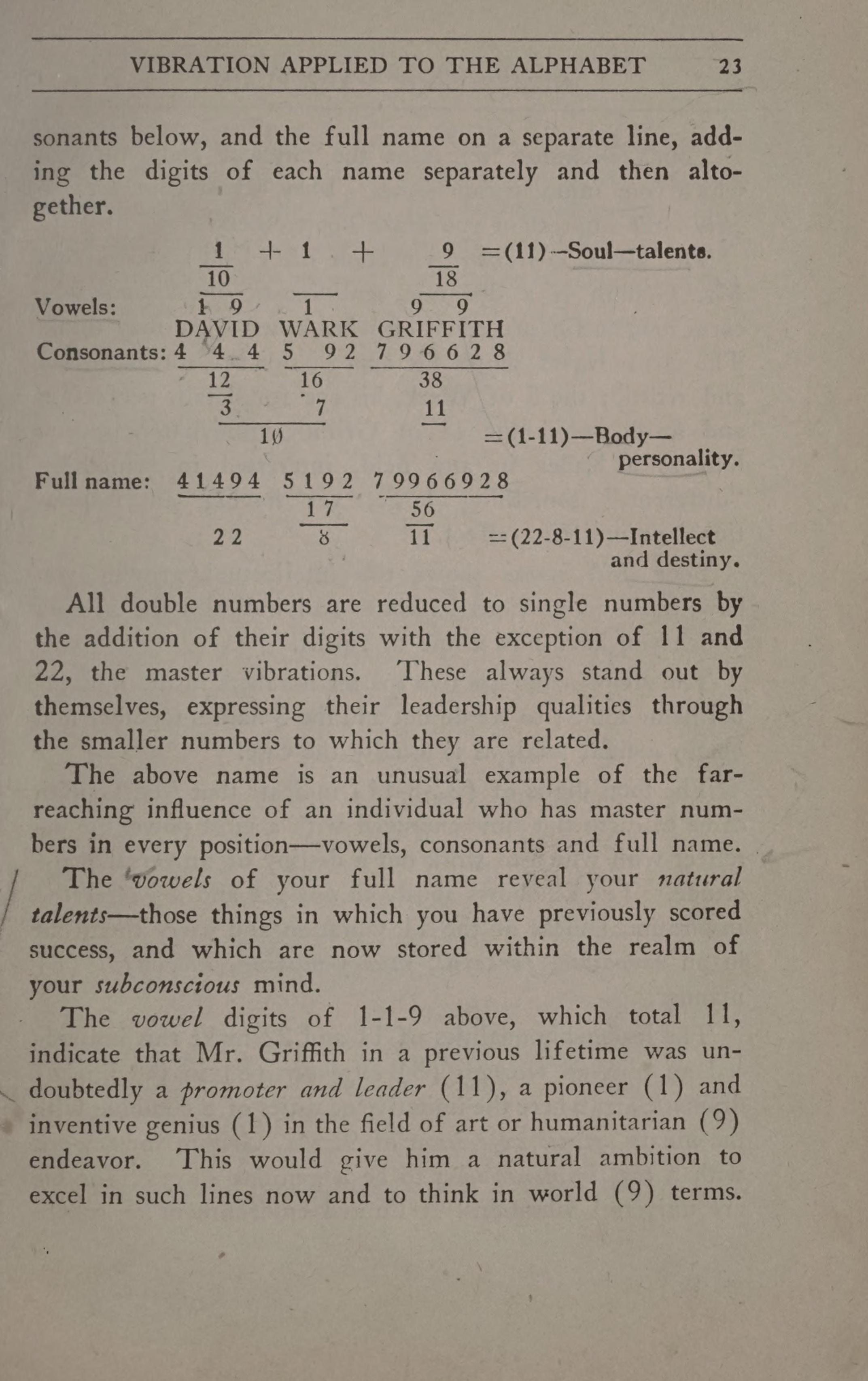
The 22-8-11 notation is the clearest case of the book's habit of recording reduced parts instead of one total. The calculator's chart keeps the three word sums (22, 17 and 56) and shows their reductions beside them; the name total is 95 and reduces once to 5.
John Davison Rockefeller: vowel and consonant subtotals
The Rockefeller chart is the book's demonstration of the vowel and consonant split. It prints 6-7-3 for the three vowel subtotals, totaling 16 and reducing to 7, and 5+5+8 = 18 for the consonants, reducing to 9. The full-name total is the exception: the book prints 5-11, keeping a master, while the calculator sums every letter to 106 and reduces to 7. The vowel and consonant numbers agree; the Expression is where the two rules part.
| Number | Raw | Result | The book |
|---|---|---|---|
| Expression | 106 | 7 | 5-11 (keeps the master) |
| Soul Urge | 43 | 7 | 6-7-3 = 16 → 7 |
| Personality | 63 | 9 | 5+5+8 = 18 → 9 |
| Chaldean name number | 90 | 9 | not in the book |
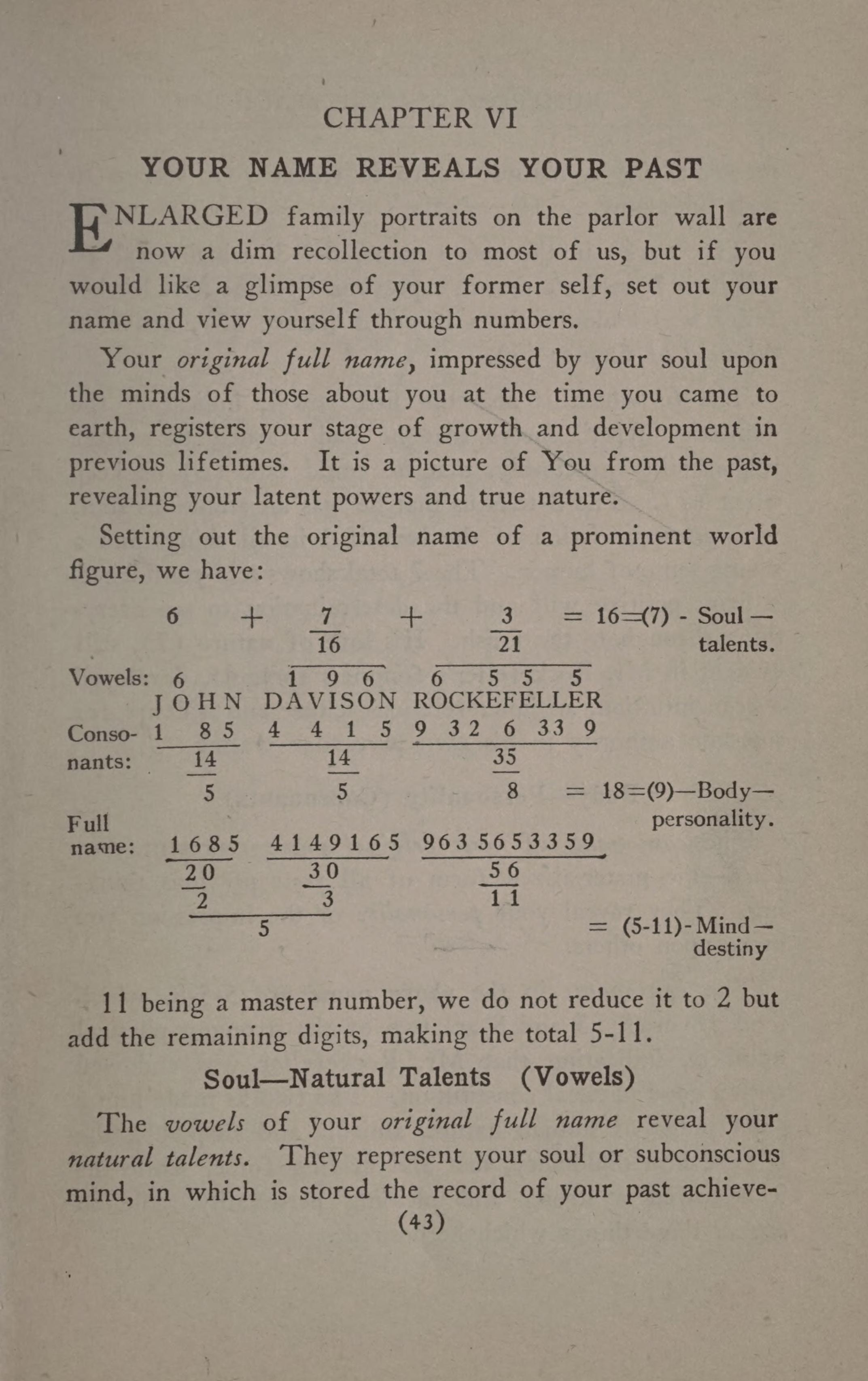
Here the intermediate numbers genuinely differ: the book adds reduced word subtotals, while this page sums every letter first. The two vowel and consonant results still meet at 7 and 9, but the Expression does not: 5-11 in the book, 7 here. That is why the raw sums sit beside the printed ones instead of claiming an exact reproduction of every line.
What the examples show
Read together, the three charts separate the decisions that a single example hides. Coolidge shows the component rule on a date; Griffith shows the master stop and the disagreement about adding name parts; Rockefeller shows the vowel and consonant split. None of the three needs a meaning for a number, and that is the point: the arithmetic can be checked without accepting an interpretation.